


HMS Victory

SKU: Artikel-Nr. :120384
In stock, delivery time: 1-2 business days
Free shipping within Germany from 200 €
Couldn't load pickup availability


Collapsible content
Show article details
HMS Victory by Warlord Games
HMS Victory
Set sail and cast off the lines!
HMS Victory was a terrifying and awe-inspiring sight for both enemy and allies. She has become one of the most famous ships in the world and remains in service with the Royal Navy to this day; as of 2019, she has accumulated a total of 241 years of service.
First Rate
HMS Victory was a first-class ship of the line, the most powerful type of ship of her time. She had three gun decks with 100 cannons. The Royal Navy had always built very large ships to fight large naval battles. The French and Spanish navies only began to build first-rate ships after the American Revolutionary War in 1783. Although commissioned in 1765, she was not commissioned until 1778. This long period of weathering meant that her timbers were well-seasoned, which is a major reason for her long service life.
Although HMS Victory was launched on May 7, 1765, she was not commissioned until 1778. Over a period of 34 years, between 1778 and 1812, HMS Victory participated in five naval battles. Commissioned during the American Revolutionary War, Victory fought in the First and Second Battles of Ushant and the Battle of Cape Spartel. During the French Revolutionary War, she served as Admiral Jervis's flagship at the Battle of Cape St. Vincent.
In 1805, she achieved lasting fame as Vice Admiral Nelson's flagship during Britain's greatest naval victory, the defeat of the French and Spanish at the Battle of Trafalgar.
Battle of Trafalgar (21 October 1805)
In early 1805, Vice-Admiral Lord Nelson commanded the British fleet during a protracted blockade of Toulon. The French fleet successfully evaded Nelson when storms broke the British blockade. After a rapid search of the Mediterranean, Nelson discovered that the French had crossed the Atlantic Ocean towards the Caribbean. He therefore set out in pursuit.
After tracking the admiral of the Franco-Spanish fleet, Pierre-Charles Villeneuve, to the Caribbean and back, Admirals Lord Nelson and Collingwood finally attacked the enemy. On September 21, 1805, just off the southwest coast of Spain, west of Cape Trafalgar, near the town of Los Caños de Meca, the two powerful fleets clashed. The French fleet was in disarray, and Nelson had devised an unorthodox tactic to decisively defeat the Franco-Spanish fleet.
Nelson organized the British ships so that they sailed perpendicularly over and through the French line. This meant that every British broadside was met with a limited French return fire.
HMS Victory attacks
For 40 minutes, the Victory was under fire from the enemy ships of the line Héros, Santísima Trinidad, Redoutable, and Neptun. She cut through the enemy line between Villeneuve's flagship Bucentaure and the Redoutable; she cut off a devastating broadside against the flagship before directly attacking the Redoutable with 74 guns. The close-quarters combat resulted in both ships locking masts. Nelson was shot dead by a French sharpshooter from the Redoutable at the height of the battle and carried below deck.
As the crew of the Redoubtable prepared to board HMS Victory, the second ship of the British windward column, HMS Temeraire, emerged from the smoke and poured devastating carronade fire into the starboard side of the Redoubtable. Her captain, with less than twenty percent of his crew fit for battle, surrendered.
More and more British ships entered the battle and gradually overwhelmed the remaining Allied vessels. Nelson did not die until 4:30 p.m., long after the British victory was already assured. Of a crew of 821 men, the Victory suffered 57 dead and 102 wounded; a considerable number for a battle of this kind.
Although he himself perished, Nelson's fleet captured or destroyed 22 enemy ships without suffering any losses. However, some of the captured ships were subsequently destroyed.
Nelson's body was brought home aboard his flagship. After lying in state in Greenwich, he was buried in St. Paul's Cathedral on January 9, 1806.
To Trafalgar
HMS Victory herself suffered damage in the battle, and after forty years of service, she was refitted as a second crew in 1807. She saw no further action. After further service in the Baltic and off the coast of Spain, Victory was placed in reserve in Portsmouth in 1812. The ship had captured the public's attention, and any threat to decommission her provoked a public outcry. For this reason, HMS Victory remains a contract ship of the Royal Navy to this day.
In the game
HMS Der Sieg is a formidable force on the table. Beyond its impressive arsenal and fantastic resilience, its inspiring presence grants a bonus to all nearby friendly ships when they undergo a skill test. If Nelson is present, this bonus is increased even further!
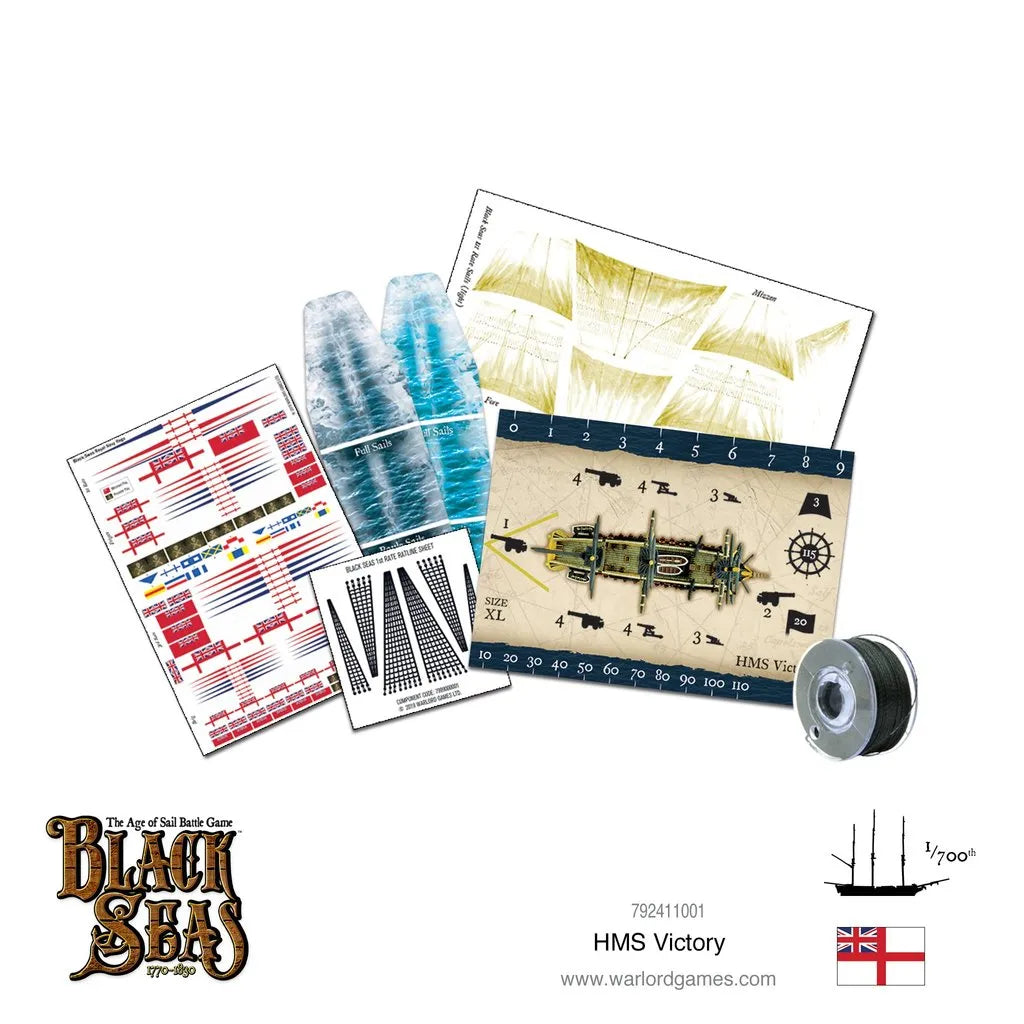
The box contains a model kit of the HMS Victory.
The miniature(s) in this set consist of metal and resin components. They are unpainted and require assembly. Paints, tools, and glue are not included in the box.
Additional information
-
Artikel-Nr.:120384
EAN:5060572505186
Hersteller Artikelnummer:792411001
Hersteller:Warlord Games
Age recommendation:
Safety notice:
-

Achtung! Für Kinder unter 12 Jahren nicht geeignet. Dieses Produkt enthält verschluckbare Kleinteile. -

Safety notice:
Manufacturer contact:
-
Warlord Games Limited | Unit 1 Central Court | Nottingham Notts. NG7 2NN | UK | https://eu.warlordgames.com/
EU-Kontakt: Christian Münzer | Peter-Krahe-Strasse 30 | 40599 Düsseldorf | DE | christian.muenzer@warlordgames.com
Our bestsellers
-

 Sale
Sale -

 Sale
Sale -

 Sale
Sale -

 Sale
Sale -

 Sale
Sale -

 Sold outDungeons & Lasers: Dwarven Miners...Sold out
 -

 Sale
Sale -

 Sale
Sale -

 Sold outDungeons & Lasers: Bal'Or by...Sold out
 -

 Sale
Sale -

 Sale
Sale -
 Sale
Sale -

 Sale
Sale -
 Sale
Sale -
 Sale
Sale -
 Sale
Sale -
 Sale
Sale -
 Sale
Sale -
 Sold outAK Oval Bases 90x52mm (4...Sold out
 -
 Sale
Sale -
 Sale
Sale -
 Sale
Sale -
 Sold outAK Cork Sheets - Fine...Sold out
 -
 Sale
Sale


